How to Score Higher in Cambridge Checkpoint English Essays: Stuck at 18/25? It’s the Formula
Your child’s English essay comes back: 16/25. You sit with them, they try harder, and the next one is 18/25. Then 17. Then 18 again. You’ve bought the assessment books. You’ve paid for tuition. And the mark just won’t move.
Does any of this sound familiar?
- The marks are stuck in the same band, no matter how many essays your child writes.
- The teacher’s comment always says something like “use more variety” or “develop your ideas further”.
- Your child says, “I don’t know what else to write.”
- You read the mark scheme yourself, and you couldn’t explain it either.
If you ticked even one, this article is for you. Because the problem usually isn’t your child’s effort, and it isn’t their English. It’s that nobody has shown them exactly what the examiner is counting.
Look at what the examiner is actually marking
Here is the top band for just one of the writing skills in the Cambridge Checkpoint English mark scheme:
Cambridge Checkpoint English · writing mark schemeA range of appropriate and varied sentence structures are used to create effect.
The use of sentence features contributes to the overall development of the text.
Almost entirely accurate grammar (tenses, agreement, and word order) with some choices to enhance and emphasise meaning.
Punctuation is correctly used to enhance the writing.
Now imagine you’re 12. What does “a range of appropriate and varied sentence structures” look like? Which punctuation “enhances” writing? How much is enough?
A mark scheme tells you what a top essay looks like. It doesn’t tell a child what to do. That’s like saying “cook something delicious” and never handing over the recipe.
So most children keep writing the way they always have, and they stay in the same band year after year.
Same child. Same story. Two versions.
Here’s what we mean. Both paragraphs below tell exactly the same story. The second one simply uses a few items from our formula.
Before: the usual way
I woke up early. I was very excited. I went to the airport with my family. The airport was very busy. There were many people. I saw a lot of planes.After: with the formula
Clutching my passport, I raced down the stairs; today was finally the day. Everything I needed was packed: my camera, my notebook and a bag of sweets. The airport – noisy, crowded and glowing with lights – felt like another planet.An illustration written by Carean to show the method. The highlighted parts are four items from our formula.
No fancy vocabulary. No extra ideas. Just the specific features the mark scheme rewards, used on purpose. That’s the difference between “this is fine” and “this is top band”.
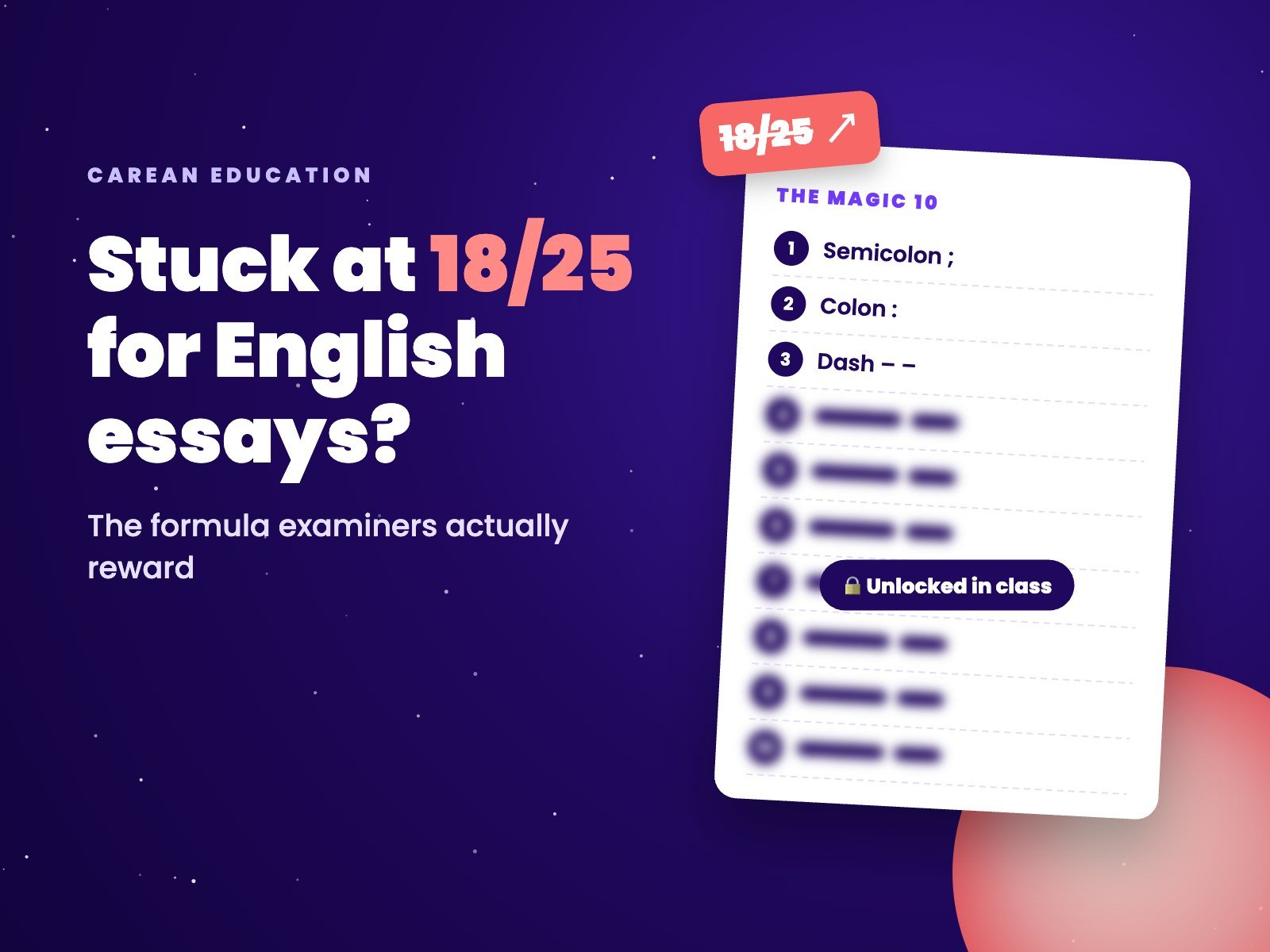
The Magic 10
At Carean, we turned every line of the mark scheme into a simple checklist. We call it The Magic 10: ten features to put into every piece of writing, each with a sentence frame a child can copy. Here are the first three.
| Item | Frame you can copy |
|---|---|
| 1. A semicolon | The sky was dark; the streets were empty. (two linked full sentences) |
| 2. A colon | I needed three things: courage, a map and a lot of luck. |
| 3. A pair of dashes or one dash | My grandmother – the bravest person I know – laughed. |
Each item ticks a specific line of the mark scheme. A semicolon, a colon and a pair of dashes are three different ways of proving that “punctuation is correctly used to enhance the writing”. The other seven cover the rest: varied sentence structures, sentence features and effects.
Never start every sentence with “I” or “The”
One of the fastest ways an examiner spots a mid-band essay: every sentence starts the same way. Our Sentence Toolkit gives students six different openers. Here are two:
| Opener | Frame | Example |
|---|---|---|
| -ing word | ___ing the ___, I / she ___ . | Clutching the ticket, she ran for the gate. |
| -ed word | ___ed, I ___ . | Exhausted, he collapsed onto the sand. |
What changes when a child has the formula
Children stuck at 16–18 out of 25 usually aren’t weak writers. They just can’t see the target. Once they can, three things happen:
- They know what to include before they start writing, so they don’t freeze at a blank page.
- They can check their own work: “Have I used all ten?” It’s a checklist, not a mystery.
- They walk into the exam confident, because they’ve practised the same formula until it’s automatic.
How we teach it
Our full Formula Workbook covers every writing skill in the mark scheme, and every type of reading question too, from Cambridge Primary Checkpoint to IGCSE.
See the other seven for yourself
Bring your child for a free trial class at Carean in Taman Molek, JB. No strings attached.
- ✓ Small groups of no more than five students
- ✓ Cambridge Primary Checkpoint to IGCSE
- ✓ Lessons that are actually fun
Mark scheme wording © Cambridge University Press & Assessment, quoted for educational commentary.
No responses yet