Cambridge Checkpoint English Reading Tips: Could You Get This Mark?
Let’s play a quick game. Below is a real question from a Cambridge Checkpoint English reading paper. It’s worth one mark. Read the passage, then answer it in your head before you scroll.
No peeking. If this were your exam, would you get the mark?
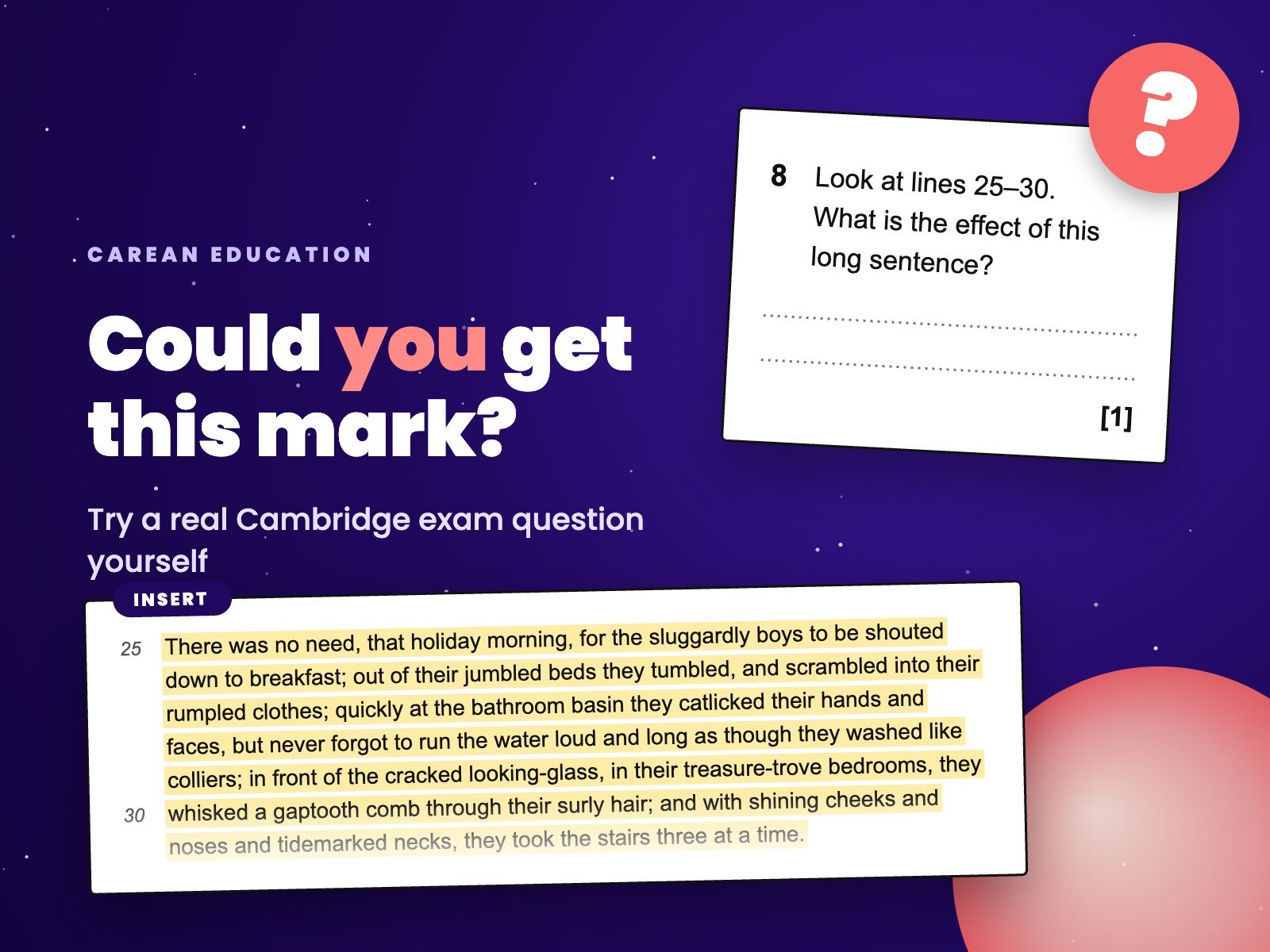
The exam questionWhat is the effect of this long sentence?
From “Holiday Memory” by Dylan Thomas. *colliers: coal miners.
Got your answer? Now tap below.
What most children write
“It makes the story more interesting.”
“It’s long because a lot of things happen.”
“It describes what the boys are doing.”
They all sound reasonable. None of them gets the mark.
Award 1 mark for:
- to emphasise the boys’ hurried actions / how excited the boys are / the number of things they are doing to get ready quickly
- it speeds up the (pace of the) text.
Notice the trick. The examiner doesn’t want a description of the sentence. They want its job: it speeds up the pace, or it shows the boys’ excitement and hurry.
Your child can understand every word of that passage and still score zero, simply because nobody told them that sentences have “jobs”.
No wonder they get stuck. And this is just one question.
Here’s the formula we teach for it
In our Formula Workbook, every type of reading question has its own formula. This one is R7. Children learn to spot the question, then fill in two blanks.
SPOT IT: “What is the effect of this long sentence?” · “The writer uses short sentences. Why?” · “How does the writer use structure to create an impact in this sentence? Give two ways.”
The writer uses a [short / long / repeated …] sentence to [job]. For “two ways”, give two different names.| Structure | Job |
|---|---|
| Short sentence / one-word sentence | creates tension or shock · emphasises a key point · slows the reader down · creates a dramatic pause |
| Long sentence (lots of commas / and) | speeds up the pace · shows lots of action happening at once / excitement / panic · shows how much information there is · shows something is complicated |
The writer uses a long sentence to speed up the pace and show how excited the boys are to get ready.
One sentence. One mark. Every single time this type of question appears.
Round two: think you’ve got it now?
The exam questionGive one reason why the writer does this.
The answer that scores zero
Many children write “to make it more dramatic” or name a vague technique. The mark scheme literally says: do not accept “rhetorical punctuation”, because it isn’t specific to these dashes in this text.
Award 1 mark for either: to contrast (between use of stations and sewers and other tunnels) / to provide additional or extra information.
Do not accept: rhetorical punctuation. This answer is not specific to the use of dashes in this text.
Here’s our formula for every punctuation question:
SPOT IT: “The writer uses two dashes. Give one reason.” · “Why has the writer used ellipsis (…)?” · “Why has the writer used inverted commas?”
The writer uses [punctuation] to [job from the bank], showing / emphasising [what it is about in THIS text].| Punctuation | Jobs (pick the one that fits) |
|---|---|
| Dash / pair of dashes – – | adds extra information · adds an afterthought · creates a contrast · creates a dramatic pause before a surprise · shows informal, chatty tone |
The writer uses a pair of dashes to create a contrast, showing that stations were built for crowds, unlike sewers and tunnels.
So, how did you do?
If you didn’t get both marks, don’t worry: most adults don’t. But think about what this means for your child. A reading paper is full of questions like these, and every question type has its own hidden rule. A child who doesn’t know the rules can lose mark after mark, even when they understood the passage perfectly.
- Their answers “sound right” but keep getting marked wrong.
- They lose marks on short 1-mark questions they “should” get.
- They understand the story, but can’t explain the writer’s choices.
If that sounds like your child, the fix is surprisingly simple: a clear formula for every question type, practised until it’s automatic. That’s exactly what our Formula Workbook does, from Cambridge Primary Checkpoint all the way to IGCSE.
Unlock the full formula book
Bring your child for a free trial class at Carean in Taman Molek, JB. No strings attached.
- ✓ A formula for every reading and writing question
- ✓ Small groups of no more than five students
- ✓ Lessons that are actually fun
Exam questions and mark scheme wording © Cambridge University Press & Assessment, quoted for educational commentary.
No responses yet